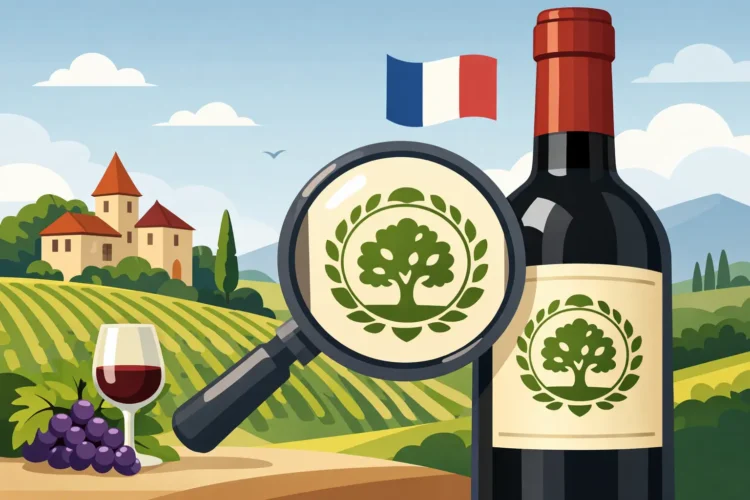
A French bottle marked HVE gives you a useful clue before the cork is even out: the grower has been independently assessed for environmental practices across the vineyard. But what does HVE mean in practical terms, and does it make the wine organic, natural or automatically better? Not quite. It is a meaningful sustainability certification, but it tells a specific part of the story.
HVE stands for Haute Valeur Environnementale, or High Environmental Value. It is a French government-backed farm certification designed to recognise estates that take measurable steps to reduce their environmental impact while protecting the landscapes in which they work.
For wine drinkers, it can be a reassuring sign that a producer is paying attention to more than yield and appearance. For growers, it is a framework that asks difficult, practical questions about biodiversity, spraying, water and soil fertility – the everyday choices that shape a vineyard year after year.
What does HVE mean for French wine?
HVE applies to farms, not simply to a single bottle or grape variety. A wine estate must meet requirements across its operation, and the certification is audited by an approved independent body. That matters because it is more than a vague claim such as “eco-conscious” or “kind to nature”.
The HVE mark seen on wine bottles refers to the highest level of the French certification, often called HVE Level 3. Earlier levels were intended to help farms work towards stronger environmental performance, but Level 3 is the level associated with the recognised HVE label used on products.
It is particularly relevant in France, where winegrowing is inseparable from place. Vineyards share space with villages, woods, rivers, hedgerows, wild flowers and working farmland. Better farming decisions can support that wider patchwork, not just the vines themselves.
The four areas an HVE vineyard must address
HVE assesses an estate through four main environmental themes. The detail is technical, but the ideas are easy to understand.
Biodiversity
An HVE grower needs to preserve or create space for life beyond the vine rows. This may mean hedges, trees, grass strips, ponds, flower-rich areas or walls that provide habitats for insects, birds and small animals.
A vineyard does not need to look wild to be biodiverse. Some of the most carefully managed estates use cover crops between the rows, retain older trees at field edges or encourage beneficial insects that help keep pests in balance. The goal is to avoid treating the vineyard as a sterile monoculture.
Plant protection strategy
This area looks at how the estate manages pests and disease pressure, including its approach to crop-protection products. Vineyards can be vulnerable to mildew, particularly in wet seasons, so there is no one-size-fits-all solution. The certification encourages growers to reduce reliance on treatments, monitor disease carefully and use alternative methods where appropriate.
HVE does not mean that all sprays are banned. That is one of the most common misunderstandings. A grower may still use certain synthetic products within the rules, which is a clear difference from certified organic farming.
Fertiliser management
Healthy soil is not simply a container for vines. It affects vine balance, water retention and the long-term character of a site. HVE examines how farms manage nutrients and fertilisers, with an emphasis on avoiding excess application and limiting the risk of pollution.
In practice, a producer may use compost, green manures or plant cover to build organic matter, while also measuring needs rather than applying fertiliser as routine insurance. These decisions can be less visible than a smart label design, but they are central to responsible viticulture.
Water management
Water use is assessed too. This is increasingly significant as hotter, drier summers affect many French wine regions. The requirements consider how a farm monitors and manages water, particularly where irrigation is used.
Not every French vineyard is irrigated, and appellation rules may restrict it. Still, responsible use and careful record-keeping matter, especially in Mediterranean areas where drought is becoming a regular concern rather than an occasional challenge.
Is HVE wine organic?
No. HVE and organic certification overlap in spirit, but they are not the same standard.
Organic wine begins in the vineyard with rules about what may be used to manage weeds, pests and disease. Synthetic herbicides, insecticides and fungicides are prohibited under organic certification. Organic growers can use certain naturally derived treatments, including copper-based products, although these are controlled because they can build up in soil.
HVE is broader in some ways because it measures biodiversity, water and fertiliser practices alongside crop protection. Yet it permits tools that organic certification does not. An HVE producer might use a limited synthetic treatment when conditions demand it, while an organic grower cannot.
Neither label alone tells you everything about the wine in your glass. An organic estate can be deeply thoughtful about biodiversity, or narrowly focused on meeting the minimum rules. An HVE estate may have remarkable habitats and carefully managed soils, while not being organic. The best approach is to see certification as helpful evidence, then get to know the producer’s methods and priorities.
HVE, biodynamic and natural wine: the difference
Biodynamic wine takes organic farming as its starting point and adds its own principles around the farm as a living whole, specific preparations and, for many producers, a lunar calendar. It is a more prescriptive philosophy than HVE, though individual practices vary widely.
Natural wine is less straightforward because there is no single legal definition that covers every bottle. Usually, it refers to wine made from organically or biodynamically farmed grapes with minimal intervention in the cellar. That may include spontaneous fermentation, little filtration and low or no added sulphites, but each producer’s interpretation can differ.
HVE concerns the farm’s environmental performance. It does not prescribe how wine must be fermented, filtered or preserved. So an HVE wine may have conventional winemaking choices in the cellar, moderate sulphites, or a more low-intervention style. You cannot tell that from the HVE mark alone.
Does HVE mean lower sulphites?
Not necessarily. Sulphites are used in winemaking to help protect wine from oxidation and spoilage, and the decision to use them happens largely in the cellar rather than the vineyard.
An HVE wine can contain added sulphites, just as an organic wine can. Some producers work with very low additions or none at all, but that is a separate choice. If you are looking for wines with no added sulphites, check the producer information rather than assuming HVE provides the answer.
This distinction is worth making because “sustainable” can easily become a catch-all word. A certification is most useful when we understand its boundaries, not when we ask it to guarantee everything.
Is HVE a good sign when choosing wine?
Yes, with a little perspective. The certification is a positive signal that a French estate has made environmental management part of its operation and submitted to an external standard. It is especially useful when comparing bottles from producers you do not yet know.
It should not, however, replace the details that make wine exciting: the grower’s story, the vintage, the appellation, the vineyard site and how the wine tastes at the table. HVE does not promise a particular flavour profile. A fresh Loire Sauvignon Blanc, a Provençal rosé and a structured Rhône red can all be HVE certified while being completely different wines.
For some drinkers, certified organic or biodynamic farming will remain the priority. For others, HVE offers a practical middle ground: credible progress in conventional viticulture, often from family estates working to improve without claiming perfection. That distinction is valuable, particularly when a difficult season makes farming choices more complicated.
How to use the HVE label when buying wine
Think of HVE as one filter among several. If environmental credentials matter most, you may want to compare HVE bottles with organic, biodynamic and no-added-sulphite options. If you are choosing for Sunday lunch, start with the food and let the certification guide you towards a producer whose approach feels right.
At Wine Affairs, we see HVE as a useful invitation to look closer, not a shortcut around curiosity. A sustainably minded bottle is even more rewarding when it suits the occasion: a bright, mineral white with fish, a generous Languedoc red for the barbecue, or a celebratory Crémant that has travelled from a thoughtfully farmed estate to your door.
Bonjour – the next time you spot HVE on a French label, you can read it as a sign of considered vineyard stewardship, then let your taste, your menu and the winemaker’s story choose the bottle.