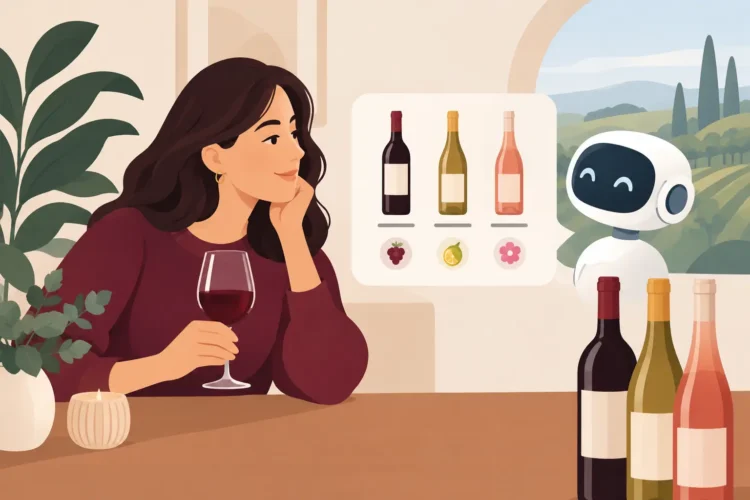
Bonjour! The best AI wine recommendations do not begin with a vague question about whether you prefer red or white. They begin with the real reason you are buying a bottle: roast lamb on a rainy Sunday, a chilled glass after work, a gift for someone who knows their Chablis, or a mixed case that makes an ordinary week feel more interesting.
That difference matters. Choosing wine online can be wonderfully convenient, but a long list of bottles is not the same as useful choice. An AI Sommelier can narrow the field quickly, translate wine language into everyday terms and suggest a French bottle that suits your taste, food and budget. Used well, it brings some of the ease of speaking to a knowledgeable shopkeeper to your phone or laptop.
What AI wine recommendations can actually do
At their most helpful, AI wine recommendations turn the details you provide into a considered shortlist. Say you enjoy fresh, citrus-led whites but find Sauvignon Blanc too sharp, and the system can look beyond the obvious. It may point you towards a dry Alsace Pinot Blanc, a mineral Loire white or a textured Chardonnay from Burgundy, depending on your budget and whether food is involved.
The technology is particularly good at spotting patterns. If you repeatedly choose juicy, medium-bodied reds with little heavy oak, it can favour wines such as Beaujolais, lighter Rhône blends or elegant Pinot Noir over dense, tannic Bordeaux. If you mention that you are serving spicy food, it can steer you away from high-alcohol reds that might make the heat feel fiercer and towards aromatic whites, rosé or a softly fruity red served lightly chilled.
It also removes some of the friction from French labels. Appellations, grape varieties and producer names carry useful information, but they can be daunting when you simply want a good bottle for dinner. A recommendation tool can explain the difference without making you feel as if you need revision notes first.
There is a practical benefit for shoppers who care about how wine is made, too. You can ask for organic, biodynamic, HVE-certified or low-intervention options, then balance those preferences with flavour and price. Sustainable farming is not a flavour profile in itself. An organic red may be light and vibrant or rich and powerful, just as a conventional one may be. Good recommendations use environmental credentials as part of the picture, not a shortcut to assuming what a wine will taste like.
The answers that make a recommendation better
AI is only as helpful as the brief it receives. “A nice red” is a perfectly fair starting point, but a few extra clues make a striking difference. Think about body first. Do you want something light and silky, or dark, warming and fuller-bodied? Then consider fruit character: red berries, blackcurrant, plum, cherry, citrus, peach or orchard fruit are all more useful than trying to name a grape you are unsure about.
Food gives the recommendation a proper job to do. A peppery Syrah may be lovely with grilled meat, while a delicate Pinot Noir could be overwhelmed by the same dish. Creamy fish pie, goat’s cheese salad, mushroom risotto and takeaway pizza all suggest different directions. If there is no food involved, say so. A bottle for sipping on its own needs balance and drinkability more than matching power.
Price and occasion matter just as much. A weekday bottle, a birthday gift and a dinner-party centrepiece should not be judged by the same measure. Tell the AI whether you would like to stay under a particular amount, whether you need six bottles, or whether you are happy to try something less familiar. This is how a recommendation becomes genuinely personal rather than merely plausible.
Previous likes and dislikes are invaluable. “I loved a soft Côtes du Rhône but disliked a very oaky Rioja” gives a clearer signal than saying you like red wine. It tells the system something about ripeness, tannin, oak and style. Even a supermarket bottle you remember enjoying can be a useful reference point, with the aim of finding an authentic French alternative from a producer worth knowing.
A useful way to describe your taste
You do not need wine vocabulary to get a good answer. Try plain language: “I want a smooth red for pasta, not too heavy, around £15,” or “I need a crisp white for prawns, but I do not like overly grassy flavours.” Add “organic if possible” or “no added sulphites” if that is a priority. The more honest the description, the better the match.
Where an AI Sommelier is strongest
An AI Sommelier is excellent at giving you a confident place to start. It is fast, patient and available when a dinner plan changes at 7pm. It can compare styles across regions, suggest alternatives when a favourite is out of stock and help build a mixed case with enough variety to keep things interesting.
It is also useful for discovery. Many wine drinkers know they enjoy Provence rosé, Malbec or New Zealand Sauvignon Blanc, but have not yet explored the French regions that might offer similar pleasures in a different accent. A crisp Picpoul de Pinet, a floral Muscat from Alsace or a lively Loire Cabernet Franc can become a new house favourite when the suggestion is tied to a flavour you already recognise.
For Wine Affairs customers, the value lies in pairing this speed with a focused, producer-led French selection. The question is not simply which bottle has the loudest label or the biggest promotion. It is which wine fits the moment, from a range chosen for character, provenance and responsible farming.
What it cannot know without you
No algorithm can taste on your behalf. It can work from product information, tasting notes, your stated preferences and patterns in similar choices, but wine remains gloriously subjective. One person’s refreshing mineral edge is another person’s austere finish. A natural wine’s savoury, wild character can be fascinating to one drinker and not at all what another had hoped for.
That is why a recommendation should be an invitation, not an instruction. If you are buying for a serious wine enthusiast, an unusual region or an older vintage may be more exciting than the safest match. If you are serving a crowd, a versatile, approachable bottle is usually the wiser choice. Context wins.
There are also details that merit a human conversation. Perhaps you are concerned about sulphites, looking for a gift with a particular story, or planning a menu with several courses. In those moments, direct advice from someone who knows the wines can add the judgement that data cannot fully replicate. AI and human expertise are not rivals. The most useful service lets each do what it does best.
How to use AI wine recommendations with confidence
Treat the first suggestion as a starting point, then ask one more question. If the AI suggests a rich Languedoc red, ask for a fresher alternative. If it recommends a dry Loire white, ask which option has more texture. Small refinements quickly reveal what you actually want.
Be open to a sensible stretch, especially when ordering a mixed case. Choose a few reliable favourites, then make room for one or two bottles from a region or grape you do not usually buy. French wine rewards this sort of curiosity. You might find that the peppery lift of a northern Rhône Syrah or the saline finish of a Corsican white is exactly what your usual choices have been missing.
Finally, remember what worked. A quick note on your phone – “great with roast chicken”, “too much vanilla oak”, “ideal chilled in the garden” – gives your next recommendation far more to work with. Over time, an AI Sommelier becomes less like a search box and more like a well-briefed wine-loving friend.
The next time you are choosing a bottle, start with the occasion and describe what you genuinely fancy. The right recommendation may lead you to a familiar favourite, or to a small French discovery you will be pleased to pour again.