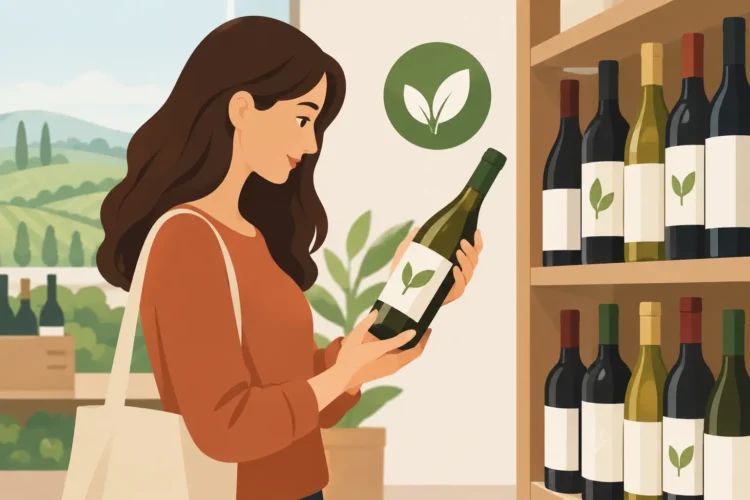
A bottle marked “natural”, “responsibly made” or “low intervention” may sound organic, but those terms do not mean the same thing. Learning how to identify organic wine starts with looking past the front-label poetry and finding the certification, producer details and farming language that support the claim.
For drinkers who care about provenance as much as what is in the glass, this is useful knowledge. Organic wine can offer a clearer picture of how grapes were grown, but it is not automatically better tasting, sulphite-free or more expensive. The most satisfying bottle is one whose credentials and style both suit your table.
What organic wine actually means
In wine, organic refers first to the vineyard. The grower must follow certified organic rules that restrict synthetic herbicides, pesticides and fertilisers, while relying on practices such as cover crops, compost, manual work and biodiversity to maintain healthy vines and soils.
For a wine to be sold as organic in the UK, it must be certified by an approved control body. That certification covers more than a winemaker simply saying they farm carefully. Vineyards are inspected and records are checked, giving the term a meaning that marketing phrases alone cannot provide.
There is one useful distinction to keep in mind. Older bottles from Europe may say “wine made from organically grown grapes”, reflecting previous rules that focused chiefly on farming. Modern EU organic wine certification also sets requirements in the winery, including lower maximum sulphite limits than conventional wine. Both can be worthwhile, but the exact wording and logo tell you more about what has been certified.
How to identify organic wine on the label
The quickest answer is to look for a recognised logo or the name of a certification body, usually on the back label. On French bottles, the EU organic leaf – a green rectangle made up of white stars – is the most widely recognised signal. It is often accompanied by a control code beginning with the country abbreviation, such as FR-BIO-01, and wording that confirms EU agriculture.
You may also see the French AB mark, short for Agriculture Biologique. This is a familiar voluntary logo for certified organic produce in France. A bottle can carry the EU leaf, the AB logo or both. Neither logo promises a particular flavour, but each indicates that the producer has met audited organic standards.
Certification bodies may be named too. Ecocert, Bureau Veritas and Certipaq are examples you might encounter on French wine labels. Their presence is more meaningful than a vague claim such as “eco-conscious”, because a named body can be traced to formal certification.
The most helpful label clues are usually:
- the EU organic leaf logo;
- the AB logo or the words Agriculture Biologique;
- a certification code, such as FR-BIO-XX;
- clear wording stating that the wine or its grapes are organically produced.
Do not worry if the front label says very little. Many thoughtful growers keep their labels beautifully simple. Turn the bottle around, check the small print, or read the merchant’s full product description before adding it to your basket.
French terms worth recognising
French labels can be particularly rewarding once you know a few phrases. “Vin biologique” means organic wine, while “issu de raisins biologiques” means made from organic grapes. “Agriculture UE” and “Agriculture non-UE” may appear near the control code, indicating whether the agricultural ingredients come from within or outside the European Union.
“Certifié biologique” is reassuring when paired with a genuine certifier, but take care with looser wording. “Culture raisonnée”, “respectueux de l’environnement” and “viticulture durable” can describe sincere efforts, yet they are not proof of organic certification. They may refer to reduced treatments, water management, wildlife protection or other worthwhile measures without meeting organic rules.
Do not confuse organic with sustainable, biodynamic or natural
Wine vocabulary overlaps, which is why labels can be confusing. Sustainable, organic, biodynamic and natural wines can share values, but they answer different questions.
Sustainable wine is about reducing environmental impact more broadly. It may include lighter bottles, renewable energy, biodiversity projects and careful water use. In France, HVE – Haute Valeur Environnementale – is a recognised environmental certification that assesses farm-level practices. HVE can be a positive sign, especially for biodiversity and reduced inputs, but HVE3 is not the same as organic certification. A vineyard may be HVE certified without being organic.
Biodynamic farming goes further than organic by treating the vineyard as a living ecosystem and following a specific set of principles, often including preparations and a seasonal calendar. Look for Demeter or Biodyvin if you want independent biodynamic certification. Most certified biodynamic estates are also organic, though it is still sensible to check the bottle or producer information rather than assume.
Natural wine is the least formal of these terms. It generally suggests organically or biodynamically grown grapes and minimal work in the cellar, but there is no single universal legal definition. One producer’s natural wine may be unfiltered with no added sulphites; another may use a small addition of sulphur for stability. That does not make it less honest, but it does mean you should ask what the producer actually does.
Sulphites: the common source of confusion
Organic wine is not necessarily sulphite-free. Sulphur dioxide has long been used in winemaking to help protect wine from oxidation and spoilage, and it is permitted in organic production within lower limits than those allowed for conventional wine.
You will often see “contains sulphites” on a label, including on organic bottles. This is required when sulphites exceed a very low threshold and does not tell you whether they were added during bottling or occurred naturally through fermentation. It is not, on its own, a reason to rule out an organic wine.
“No added sulphites” is a more specific claim. It means the producer has not added sulphur dioxide, although tiny naturally occurring amounts can still be present. These wines can be vivid and delicious, but they sometimes need more careful storage and may evolve quickly once opened. If you enjoy fresh, energetic styles, they are well worth trying; if you want a bottle to keep for years, a modest amount of sulphur can be a sensible safeguard.
Use the producer, not just the badge
A logo provides a valuable starting point, but a good wine merchant should help you understand the story behind it. Look for details about the estate, its region, grape varieties, certification and approach in the cellar. A producer in the Loire who works organically on Chenin Blanc faces different weather pressures from one tending Grenache in the Languedoc, and their choices will reflect that.
Organic farming is not easy or uniform. In wet vintages, fungal disease pressure can be severe, and growers must act carefully to protect a crop without reaching for the systemic treatments used in conventional viticulture. Some organic growers may use permitted copper-based treatments, for example. This is one reason organic should not be treated as a simplistic purity test. It is a regulated farming system with real benefits and real practical limits.
Transparent producers are usually happy to explain their choices: whether they plough between rows, encourage insects and wildflowers, harvest by hand, use indigenous yeasts, filter their wines or add a little sulphur at bottling. Those details help you find a wine that matches your values and your palate.
A practical bottle-checking routine
When browsing in a shop or online, start with the back label and product information. First, look for the EU leaf, AB mark or named certifier. Next, separate certified organic language from broader environmental claims. Then check whether biodynamic, no added sulphites or vegan credentials matter to you personally, rather than assuming one label covers everything.
Finally, choose for the occasion. An organic Provence rosé can be a brilliant garden-party bottle; an organic Beaujolais may suit roast chicken; a textured, organically farmed Alsace white can shine with a creamy mushroom dish. Farming credentials are part of the pleasure, not a substitute for style, freshness and good food matching.
At Wine Affairs, clear producer notes and filters can make that final step less of a label-reading exercise and more of a discovery. Bonjour to better questions at the bottle shelf: who made this, how were the grapes grown, and will I enjoy pouring it tonight?