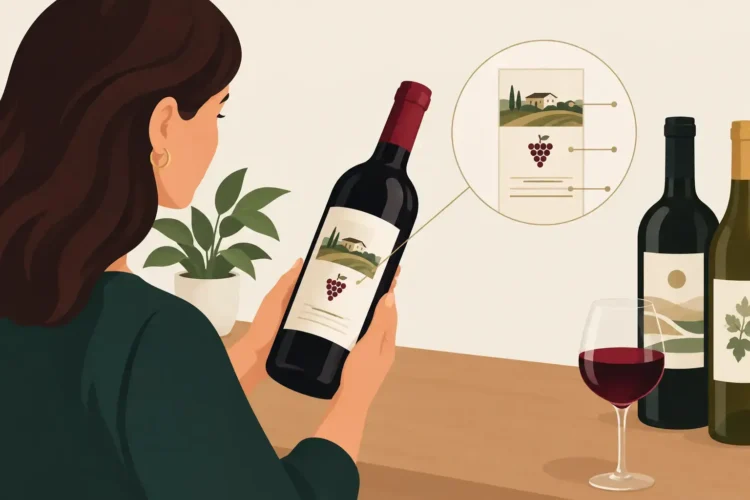
A French wine label can look like a small exam paper: a château name you cannot pronounce, a village in tiny type and perhaps no grape variety in sight. Yet once you know how to read wine labels, those details become useful clues to flavour, quality, origin and the way the grapes were grown. Bonjour, better bottle choices are much closer than they look.
Start with where the wine comes from
For French wine, place often tells you more than grape variety. This is the old-world approach: a label may lead with Burgundy, Sancerre or Côtes du Rhône because the region’s rules, climate and traditions help define what is in the bottle.
Look first for the appellation, usually one of the most prominent lines on the front label. An appellation is a legally defined area with rules about permitted grapes, yields and winemaking. It is not an automatic guarantee that you will love the wine, but it is a reliable starting point for understanding its character.
A Chablis label, for example, points to Chardonnay from northern Burgundy, typically dry, fresh and mineral in style. Sancerre usually means Sauvignon Blanc from the Loire, often zesty with citrus, herbs and a flinty edge. A label stating Côtes du Rhône may contain Grenache, Syrah and Mourvèdre, giving you a generous red with ripe fruit and spice.
The narrower the place name, the more specific the origin generally becomes. A bottle labelled Bourgogne is a regional Burgundy. A village name such as Meursault or Gevrey-Chambertin is more precise. A premier cru vineyard designation is narrower still. That does not mean a premier cru is always the right purchase for Tuesday night pasta, only that it comes with a more particular place and usually a higher price.
AOP, IGP and Vin de France explained
These terms are worth recognising, but they are not a simple quality ladder.
AOP or AOC means Appellation d’Origine Protégée or Contrôlée. It identifies a wine made according to the rules of a defined French appellation. You may see both terms, particularly on bottles using older wording.
IGP means Indication Géographique Protégée. It still identifies an origin, but usually gives the winemaker more freedom over grape choice and style. An IGP Pays d’Oc, for instance, may clearly state Syrah, Viognier or Pinot Noir on the label and can offer excellent value.
Vin de France has the broadest designation. It can be a brilliant sign of a producer choosing freedom over rigid appellation rules, perhaps blending grapes or sourcing from more than one area. Judge it by the producer, the description and your preferred style, not by assumption.
Find the producer before chasing the grand name
The producer’s name is often the best reason to choose one French bottle over another. It may be a family estate, domaine, château, cooperative or négociant. These terms describe different business models, rather than a simple good-better-best scale.
A domaine commonly indicates an estate with its own vineyards. A château is widely used in Bordeaux and beyond, but does not necessarily mean a grand country house. A cooperative pools grapes from local growers, which can produce dependable, good-value wines. A négociant may buy grapes, juice or finished wine, then blend and bottle it. Some of France’s most respected names are négociants, so this is not a red flag.
Look for wording such as mis en bouteille au domaine or mis en bouteille à la propriété. This means the wine was bottled at the estate. It can be a helpful provenance clue, although it is not the only route to quality. What matters most is whether the producer’s approach and style suit the occasion.
How to read wine labels for grape clues
French labels do not always list grapes, especially in famous appellations. Knowing a few regional shortcuts makes the label far less mysterious.
In Burgundy, white wine is overwhelmingly Chardonnay and red wine is usually Pinot Noir. In Alsace, grape varieties are commonly shown, with Riesling, Pinot Gris, Gewurztraminer and Pinot Blanc among the familiar names. In the Loire, Sauvignon Blanc dominates Sancerre and Pouilly-Fumé, while Chenin Blanc is central to Vouvray and the Loire’s brilliant dry, sweet and sparkling wines.
Bordeaux red normally blends Cabernet Sauvignon, Merlot and Cabernet Franc, among others. Southern Rhône reds tend towards Grenache, Syrah and Mourvèdre. Provence rosé is often a blend, commonly including Grenache, Cinsault and Syrah. A blend is not a compromise: it is frequently the winemaker’s way of balancing perfume, body, freshness and texture.
If a grape is printed clearly on the front, it is often an IGP or Vin de France wine, although there are exceptions. This makes it a practical option when you know you enjoy a particular variety but want to try a French interpretation of it.
Read the vintage with context
The vintage is the year the grapes were harvested, not the year the bottle was released. Weather varies from year to year, so it can influence ripeness, acidity and structure. In cooler years, reds may be more savoury and fresh; in warmer years, they can be riper and fuller.
Vintage matters most for wines intended to age and for regions with variable weather, such as Burgundy, Bordeaux and the Loire. For a young, fruit-forward white, rosé or everyday red, producer and storage are often more useful guides than chasing a supposedly perfect year.
Be careful with non-vintage sparkling wine. “NV” means it is blended from more than one harvest, often deliberately, to create a consistent house style. It is not inferior by default. For many sparkling wines, consistency is exactly the point.
Use alcohol percentage as a body clue
The ABV, or alcohol by volume, appears on the label and is more revealing than it first seems. It cannot tell you whether a wine is dry or sweet, but it can hint at weight and ripeness.
As a broad guide, a wine around 11 to 12% ABV may feel lighter and fresher, although there are plenty of exceptions. Around 12.5 to 13.5% often sits in a comfortable middle ground. At 14% or above, expect a riper, fuller style more often than not, especially in red wine. Climate, residual sugar and winemaking choices all affect the final figure, so treat ABV as a clue rather than a verdict.
This is useful when matching wine to food. A 12% Loire Cabernet Franc can be lively with roast chicken or charcuterie, while a 14.5% southern French red may be happier beside slow-cooked lamb or a rich aubergine bake.
Look for sustainable, organic and biodynamic credentials
For many wine drinkers, how a wine is made matters as much as where it comes from. Labels can help, but the language needs a little decoding.
Organic wine means grapes are grown without synthetic herbicides, pesticides or fertilisers, under certified standards. The EU organic leaf logo is a clear sign to look for. Organic does not mean sulphite-free, nor does it guarantee a particular flavour. It speaks first to vineyard and production rules.
Biodynamic farming goes further, treating the vineyard as a living ecosystem and following a certified set of agricultural principles. You may see Demeter or Biodyvin certification. Some people are drawn to the philosophy; others simply enjoy the vitality and precision that thoughtful vineyard work can bring. The individual producer remains more important than the badge alone.
HVE, short for Haute Valeur Environnementale, is a French environmental certification. HVE3 is its highest level and focuses on biodiversity, plant-protection strategy, fertiliser management and water use. It is not the same as organic certification, but it can indicate a serious effort to reduce environmental impact.
Terms such as “natural” or “low intervention” are less tightly defined. They often suggest minimal additions and gentler handling, but practices vary greatly. If you are looking for no added sulphites, check that wording specifically rather than assuming a natural wine meets that preference.
Turn the back label into a practical decision
The back label may mention tasting notes, food pairings, serving temperature, importer details, allergens and sulphites. “Contains sulphites” is required for most wines because sulphur dioxide is widely used to protect freshness and stability. It does not mean the wine has unusually high levels, and it is not a reliable measure of quality.
Treat tasting notes as direction, not destiny. “Blackberry, pepper and violet” suggests a fragrant, dark-fruited red. “Lemon zest, saline and orchard fruit” points towards a crisp white with freshness. Words such as oak, vanilla or toast signal barrel influence, while “unfiltered” may mean a little sediment or haze is possible. Neither is inherently better: it depends whether you want polish and richness, or a more immediate, unvarnished expression.
A useful label-reading habit is to connect four details before buying: origin, producer, vintage and farming credentials. Then add the ABV and description to judge whether it suits your meal, mood and budget. At Wine Affairs, those same details make it easier to compare French regions and discover bottles that feel personal rather than random.
The best label is not necessarily the one with the longest pedigree or most impressive-looking crest. Choose the bottle whose place, people and style make you want to pour a glass, then keep a note of what you enjoyed. Your own palate is the most valuable bit of wine education you will ever build.