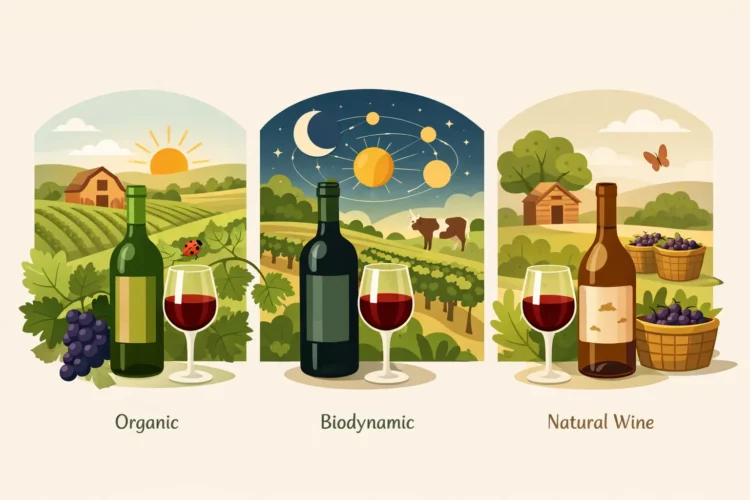
A cloudy Loire Chenin with a faintly cider-like edge, a polished organic Bordeaux and a vivid, juicy Beaujolais can all be described as ‘better for the planet’. Yet organic vs biodynamic vs natural wine is not a simple ladder of good, better and best. The terms describe different choices in the vineyard and winery – and those choices can affect flavour, consistency, price and how a bottle behaves once opened.
For drinkers who care about provenance, the useful question is not ‘which category should I always buy?’ It is: what matters to me in this bottle? If you want clear farming standards, organic certification may be the answer. If you are drawn to a grower’s whole-estate philosophy, biodynamic wines are worth seeking out. If you want the most hands-off expression of grape and place, natural wine may appeal, with a few important caveats.
What organic wine actually means
Organic wine begins in the vineyard. Grapes must be grown without synthetic herbicides, pesticides or fertilisers. Instead, growers use techniques such as cover crops between rows, compost, grazing animals, beneficial insects and careful canopy management to keep vines healthy.
That does not mean organic vineyards are simply left to fend for themselves. Viticulture is hard work, particularly in wet or humid regions where mildew pressure can be fierce. Organic growers are permitted to use certain naturally derived treatments, notably copper and sulphur, although their use is controlled. The aim is to work with soil life and biodiversity rather than rely on routine synthetic chemistry.
In France and across the EU, certified organic wine is governed by formal rules. Look for recognised organic certification on the label or back label if that assurance matters to you. A producer may farm organically but choose not to certify, often because of cost, paperwork or a belief that their reputation speaks for itself. Equally, a bottle carrying the word ‘organic’ should offer a more meaningful claim than vague green imagery on a label.
Organic certification also covers winemaking, but it does not mean nothing can be added in the cellar. Winemakers may use a range of permitted techniques and additions, including limited sulphur dioxide. This is why an organic wine can taste beautifully classic: clean, bright, precise and entirely at home beside a roast chicken or a Sunday lunch.
Biodynamic wine: organic farming with a wider philosophy
Biodynamic farming meets organic principles and then goes further. Its central idea is that a vineyard is a living ecosystem, connected to its soils, plants, animals, people and surrounding landscape. The grower’s job is to strengthen that system’s natural balance.
In practice, biodynamic estates commonly make their own composts, encourage biodiversity and use herbal preparations in tiny quantities. Some plan particular vineyard tasks around lunar and planetary calendars. That last point can sound mystical, and it is fair to be sceptical of claims that cannot be neatly measured in a laboratory. But the day-to-day reality is often very practical: closer observation of each parcel, more manual work and a long-term focus on soil health.
The best reason to choose biodynamic wine is not a promise that it will automatically taste superior. Fine and disappointing bottles exist in every category. Rather, biodynamics can signal a producer who is deeply involved in their vineyards and willing to farm with considerable care, often at significant cost and risk.
Two names you may see are Demeter and Biodyvin, both of which certify biodynamic practices under their own standards. Their presence gives useful reassurance, although some highly regarded estates follow biodynamic methods without displaying either logo.
Biodynamic wines are not necessarily ‘funky’, cloudy or sulphite-free. Many of France’s most refined, ageworthy wines are biodynamic, from structured Rhône reds to focused Alsace Riesling and mineral Burgundy Chardonnay. Think of biodynamics primarily as a farming and estate-management approach, rather than a prediction of a particular flavour.
Natural wine: more about the cellar than certification
Natural wine is the loosest and most debated term of the three. There is no single legal definition that applies everywhere, and certification is less consistent than it is for organic or biodynamic wine. Broadly, natural wine is made from grapes grown organically or biodynamically, then handled with as little intervention as possible in the winery.
That usually means fermenting with native yeasts already present on the grapes and in the cellar, avoiding or minimising additives, using little filtration and adding no sulphur dioxide or only a very small amount. Many natural winemakers also avoid practices such as acidification, concentration, heavy oak flavouring and aggressive fining.
The result can be thrilling. A natural Gamay may taste like freshly crushed raspberries; a skin-contact white from Alsace or the Loire can bring tea-like texture, citrus peel and spice; a pétillant naturel can feel joyful and alive. These are wines that often make a table conversation more interesting.
But minimal intervention does not remove the need for skill. It raises the stakes. Without careful hygiene, sound fruit and thoughtful decisions, a wine can become overly volatile, mousy, oxidised or simply unstable. A little cloudiness is not a fault in itself, nor is sediment. Strong smells of nail varnish, bruised apple or damp cardboard, however, are not proof of authenticity. They may indicate a wine that has not travelled or been stored well.
Natural wine can therefore be less predictable from bottle to bottle than conventionally made wine. This is part of its appeal for some drinkers and a drawback for others. If you are opening a special bottle for a dinner party, ask for a recommendation from a trusted merchant rather than assuming every natural wine will suit every guest.
Organic vs biodynamic vs natural wine: the practical difference
The easiest way to separate the terms is to consider where the main emphasis lies. Organic wine has certified restrictions on synthetic inputs in the vineyard, alongside rules for winemaking. Biodynamic wine builds on organic farming with a whole-farm philosophy and specific preparations or practices. Natural wine usually describes low-intervention winemaking, with the expectation that the grapes have been farmed organically or biodynamically.
There is plenty of overlap. A wine can be organic, biodynamic and natural. It can be organic but made in a conventional, highly controlled cellar. It can be biodynamic and polished, stable and suitable for ageing. And a wine marketed as natural may have no official organic certificate, even when the producer farms responsibly.
None of these labels tells you everything. A conscientious HVE-certified French grower may be making excellent progress on biodiversity and water management without being organic. A small organic estate may need to spray more copper in a difficult season than it would like. Sustainability is not a badge that ends the conversation; it is a set of choices made over many vintages.
What about sulphites?
Sulphites are often the source of the greatest confusion. Sulphur dioxide has been used in winemaking for centuries because it protects wine from oxidation and unwanted microbial activity. It can help a bottle arrive tasting as its maker intended, especially after a journey or a few years in a cellar.
All wine contains some naturally occurring sulphites from fermentation. ‘No added sulphites’ means none have been added, not that the wine contains absolutely zero. Organic wines may contain added sulphur within lower permitted limits than conventional wines. Biodynamic producers may use it sparingly. Natural producers may use none, or a small dose at bottling.
Lower sulphur does not automatically mean better wine, healthier wine or a guaranteed headache-free morning. Alcohol, dehydration, sleep and individual sensitivity are far more common culprits. For most people, the more useful consideration is style: do you want a delicate, immediate wine with low added sulphur, or a bottle built for dependable freshness and ageing?
How to choose a bottle with confidence
Start with the occasion, then use the farming method to narrow the field. For an easy midweek white, an organic Picpoul or Sauvignon Blanc can offer freshness and reassurance without asking you to adapt to an unfamiliar style. For a slower meal and some curiosity, try a biodynamic Jura Chardonnay or Rhône red and see how the producer’s precision shows through. For an aperitif with friends who enjoy surprises, a well-made natural sparkling or light red can be great fun.
When you are choosing, these four questions cut through most label jargon:
- Is the wine certified organic or biodynamic, or does the producer simply describe their approach?
- Is it made with no added sulphites, low sulphites or a conventional amount?
- What style should you expect: crisp and classic, textured and savoury, or deliberately wild and adventurous?
- How has it been stored and how should it be served?
Serve many natural and low-sulphur reds slightly cool, around 14-16°C, rather than at a warm room temperature. A gentle swirl and ten minutes in the glass can help a bottle settle after travel. If a wine seems reduced, showing struck-match or closed aromas, a splash into a carafe may bring it round. If it still smells genuinely unpleasant, trust your senses.
Wine Affairs makes it easier to shop by method alongside region, grape and occasion, but the most rewarding route is still personal: tell us whether you are cooking, celebrating or simply trying something new. The right bottle may be organic, biodynamic or natural. What matters is that it is delicious, honestly made and the sort of wine you will want to pour again.