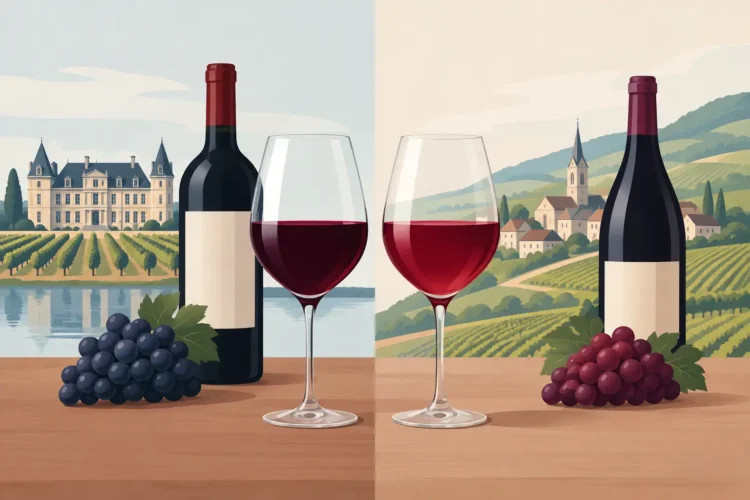
A bottle labelled Bordeaux and a bottle labelled Burgundy may both be French red wine, yet they can feel like entirely different ideas of wine. In the Bordeaux versus Burgundy wine debate, the most useful question is not which region is better. It is which style suits the food, the moment and your own palate.
Bordeaux often brings structure, dark fruit and a composed, classic feel. Burgundy is usually more about perfume, freshness and the small details of a particular hillside. Both can be thrilling, both can be great value, and both can become very expensive at the top end. The good news is that you do not need a cellar or a sommelier’s vocabulary to enjoy either.
Bordeaux versus Burgundy wine: the essential difference
The simplest distinction is the grape. Red Bordeaux is generally a blend led by Cabernet Sauvignon, Merlot and Cabernet Franc, sometimes with smaller portions of Petit Verdot or Malbec. Red Burgundy is, with rare exceptions, Pinot Noir.
That one fact explains a great deal. Cabernet Sauvignon gives Bordeaux blackcurrant, cedar, firm tannin and the capacity to age. Merlot softens the blend with plum fruit and a rounder texture. Pinot Noir, meanwhile, is naturally lighter in colour and tannin, but capable of remarkable fragrance: red cherry, raspberry, rose, woodland floor and subtle savoury spice.
White wines follow the same regional logic. White Burgundy is predominantly Chardonnay, ranging from crisp, mineral Chablis to richer, oak-influenced styles from the Côte de Beaune. White Bordeaux is usually a blend of Sauvignon Blanc and Sémillon, often zesty and herbal when dry, or rich and honeyed in its sweet forms such as Sauternes.
Neither region is one fixed taste. A supple, Merlot-led Bordeaux from the Right Bank can be generous and immediately welcoming. A Côte de Nuits Burgundy can be concentrated, structured and built for patience. Region is your starting point, not the whole story.
How the landscapes shape the glass
Bordeaux is a large region in south-west France, shaped by the Gironde estuary and its rivers. Its famous left-bank vineyards, including Médoc and Graves, have gravelly soils that suit Cabernet Sauvignon. The right bank, around Saint-Émilion and Pomerol, has more clay and limestone, where Merlot and Cabernet Franc shine.
This geography encourages blending. A producer can balance one grape’s perfume with another’s backbone, or use a warmer vintage to soften a cooler one. That is one reason Bordeaux can feel polished and dependable, particularly from producers with experience across varied sites.
Burgundy, further east, is smaller in scale and more fragmented. Here, location is the headline. A vineyard a few metres away may have a different soil, exposure or drainage, and therefore a different character. Burgundy labels often foreground the village or vineyard rather than the grape because Pinot Noir and Chardonnay are expected.
You may see Bourgogne, then a named village such as Mercurey or Pouilly-Fuissé, followed by premier cru and grand cru. These are quality and site designations, but they are not a guarantee that one bottle will suit every drinker. The producer and vintage still matter enormously.
Taste, texture and ageing
If you enjoy a red with depth, black fruit and a little grip, Bordeaux is often the easier first choice. Younger examples can show blackberry, cassis, plum, tobacco, graphite and baking spice, especially if aged in oak. Tannins give the wine a drying sensation on the gums, which is why Bordeaux comes alive beside food.
Many affordable Bordeaux wines are made to drink within a few years, so do not assume you must wait a decade. However, better examples from strong vintages can develop beautifully, gaining notes of leather, cedar, dried fruit and savoury complexity over time.
Burgundy tends to persuade in a quieter way. Pinot Noir’s tannins are generally finer and the fruit more red than black: cherry, cranberry, wild strawberry and redcurrant. With bottle age, it can move towards mushroom, forest floor, game and dried rose. The texture is often silky, but a good Burgundy should still have energy and length.
A useful rule of thumb: choose Bordeaux when you want power, structure and darker flavours; choose Burgundy when you want fragrance, finesse and freshness. Then break the rule whenever a particular bottle calls for it.
The white wine comparison
White Burgundy and white Bordeaux are just as distinct, though their price and reputation can make the choice feel needlessly complicated.
Chablis is one of the clearest entry points to white Burgundy. Made from Chardonnay, it is often dry, bright and mineral, with lemon, green apple and a saline edge. Further south in Burgundy, wines from Meursault, Mâconnais or the Côte Chalonnaise can be broader, riper or more creamy, sometimes with toast and hazelnut from barrel ageing.
Dry white Bordeaux usually feels more aromatic and direct. Sauvignon Blanc contributes grapefruit, gooseberry, citrus and cut-grass notes, while Sémillon can add waxy texture and a softer, peachier fruit character. It is a brilliant partner for seafood, goat’s cheese and spring vegetables. If you like your whites fresh but not thin, seek a blend with a meaningful proportion of Sémillon.
For a celebratory bottle with roast chicken or creamy fish dishes, white Burgundy is often the answer. For prawns, grilled asparagus or a sunny aperitif, dry white Bordeaux can be a wonderfully lively alternative.
Food pairings that make the decision easier
Wine pairing is not about getting it perfect. It is about matching weight, flavour and texture.
Bordeaux reds have the frame for lamb, roast beef, venison, mushroom pie and hard cheeses. A Merlot-led Bordeaux is especially good with duck breast or a Sunday roast, while a Cabernet-led style welcomes a properly charred steak. If the dish is lean and delicate, choose a softer, less tannic bottle or give the wine some air first.
Burgundy Pinot Noir is one of the most versatile reds at the table. Try it with roast chicken, pork, duck, salmon, lentils, mushrooms or charcuterie. Its bright acidity makes it useful with dishes that include herbs, acidity or earthy vegetables. Lightly chill a young Burgundy for 20 minutes in the fridge before serving, particularly in a warm room, and its perfume will be clearer.
The same principle applies to whites. White Bordeaux loves oysters, grilled fish and goat’s cheese. White Burgundy has enough texture for lobster, chicken in a cream sauce, risotto and richer vegetarian cooking.
Value, labels and sustainable choices
Burgundy’s finest names have become scarce and costly, but that does not mean Burgundy is only for grand occasions. Look beyond the most famous villages towards Bourgogne Pinot Noir, Hautes-Côtes de Beaune, Hautes-Côtes de Nuits, the Côte Chalonnaise and Mâconnais. These areas can offer the region’s hallmark brightness and charm at a more comfortable price.
Bordeaux also rewards a little label reading. Lesser-known appellations, such as Bordeaux Supérieur, Fronsac, Castillon Côtes de Bordeaux and Côtes de Bourg, can provide excellent value, particularly if you enjoy Merlot’s plush texture. A château name alone is not a shortcut to quality, so producer care matters more than grand-looking packaging.
For environmentally minded drinkers, both regions have growers working organically, biodynamically or under HVE, France’s High Environmental Value certification. These terms describe farming choices rather than a guaranteed flavour profile. Organic farming avoids synthetic herbicides and pesticides; biodynamic farming takes a broader, nature-led approach; HVE assesses areas including biodiversity and water management.
The most rewarding approach is to treat these credentials as useful context alongside the producer’s style. A low-intervention Pinot Noir may be deliciously vivid and lightly textured, while another may be deliberately wild. An organic Bordeaux may be deeply traditional in taste, or strikingly fresh and modern. If you are unsure, tell Wine Affairs what you normally enjoy, what you are cooking and whether sustainable farming is a priority. Bonjour, that is exactly the sort of choice we enjoy helping with.
So, which should you pour?
Choose Bordeaux when the meal is hearty, you like darker fruit and savoury oak, or you want a bottle with enough structure to develop over a few years. Choose Burgundy when you are drawn to aromatic reds, elegant textures and wines that can complement rather than dominate dinner.
Most importantly, give yourself permission to compare them without turning it into an exam. Open a Merlot-led Bordeaux with roast lamb one weekend, then a Pinot Noir with chicken and mushrooms the next. The better bottle is the one that makes you reach for another glass, notice the food more keenly and start planning your next French supper.