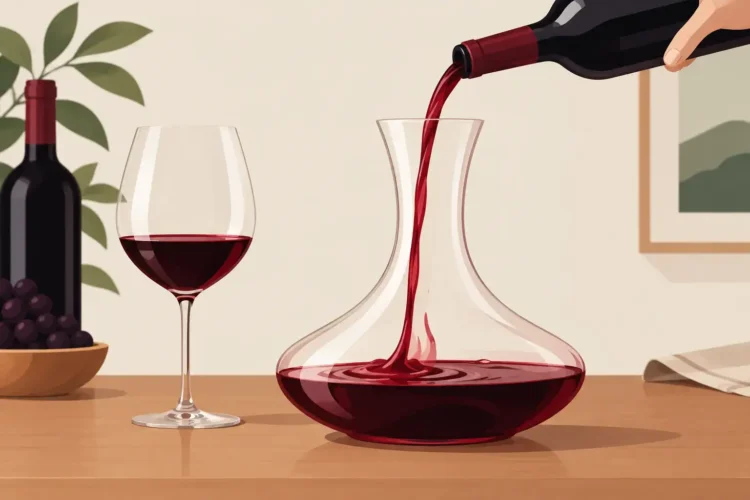
A wine can be beautifully made, stored with care and served at the right temperature, yet still seem tight or oddly muted in the glass. Often, the answer is simply air. If you are wondering when should wine be decanted, the useful answer is not “every bottle”. Decant wines that need to open up, or bottles where you want to leave sediment behind. Pour the rest straight into the glass and enjoy them as they are.
Decanting is a small ritual, but it need not be a formal one. A clean jug, carafe or decanter will do the job. What matters is understanding what the wine is asking for.
What decanting actually does
Decanting has two purposes. The first is aeration: exposing wine to oxygen so its aromas and flavours become more expressive. A young red may smell reserved at first, then reveal dark fruit, spice, flowers or savoury notes after some time in a decanter.
The second is separation. Older wines, particularly mature reds, can form sediment as natural pigments and tannins settle over time. Sediment is harmless, but it can feel gritty on the tongue. Decanting lets you pour the clear wine away from that deposit.
These are different jobs, and they call for different approaches. A young, structured red generally benefits from plenty of air. An old bottle needs a gentler pour and much less time exposed to oxygen.
When should wine be decanted? Start with the style
The wines most likely to reward decanting are young reds with firm tannins, concentrated fruit or a little bottle age ahead of them. Think Cabernet Sauvignon-dominant Bordeaux, a youthful Rhône blend, serious Syrah, Malbec, Nebbiolo, Barolo, Brunello di Montalcino and powerful Languedoc reds. Their tannins can feel drying or angular immediately after opening, especially alongside food.
For these bottles, decanting softens the overall impression. It does not remove tannin, but it can make the wine feel more harmonious as the fruit and perfume emerge. A good rule is 30 minutes for a moderately structured young red and one to two hours for a particularly dense, youthful bottle.
Some wines made with low-intervention methods may also change noticeably after opening. Natural, organic and biodynamic wines can be wonderfully vivid, but an initially reductive aroma – sometimes reminiscent of struck flint, cabbage or a just-lit match – may lift with air. Do not assume this means the wine is faulty. Pour a small glass, give it a swirl and reassess after ten minutes. If it is still closed, decant gently.
Young reds: give structure time to relax
A young Bordeaux or Rhône wine often has the clearest case for decanting. It may have been made for several years of development, even if it is perfectly enjoyable now. Air helps its components settle into place.
Use a broad-based decanter if you have one, as more surface area encourages faster aeration. If not, a jug is entirely acceptable. Pour the wine in with a confident, steady stream, then taste it after 20 minutes. There is no need to follow a timer blindly: one wine may blossom quickly, while another remains stubbornly quiet for an hour.
Mature reds: decant for sediment, not speed
Older wines are more fragile. Their aromas can be extraordinary – dried rose, leather, tobacco, truffle, woodland and soft autumn fruit – but too much oxygen can cause them to fade quickly.
Stand a mature bottle upright for several hours, ideally a day, before opening so any sediment falls to the bottom. Open it carefully, then pour slowly into a decanter, stopping as soon as you see cloudy sediment approaching the neck. A light or candle behind the bottle can make this easier, though good daylight works just as well.
With a mature red, taste first. It may need only a few minutes in the decanter, or it may be better poured directly into glasses with care. For a prized old bottle, gentle handling is more valuable than dramatic aeration.
Wines that usually do not need decanting
Most fresh, aromatic whites and rosés are made to be poured and enjoyed. A crisp Loire Sauvignon Blanc, Provençal rosé, dry Muscadet or lively Alsace Riesling is usually at its best cold, bright and immediate. Decanting can allow those delicate aromas to drift away and the wine to warm too quickly.
Sparkling wine should almost never be decanted. Champagne, Crémant and pétillant wines rely on their bubbles for texture and freshness. Pour them into suitable glasses just before drinking.
That said, there are worthwhile exceptions. Fuller-bodied whites, especially oak-aged Burgundy, rich Rhône whites, serious Chenin Blanc and some skin-contact or orange wines, can benefit from 15 to 30 minutes of air. Decanting may reveal creamier textures, orchard fruit, nuts, spice and mineral complexity that were initially hidden by a cold serving temperature or a recently opened bottle.
The key is restraint. You can always give a wine more air, but you cannot put its freshness back once it has faded.
A practical way to decide at home
You do not need to predict a wine’s future from the label. Open the bottle a little ahead of dinner, pour a small taste and pay attention. If it feels expressive, balanced and aromatic, leave it alone. If it seems tight, excessively tannic, muted or slightly reductive, decant it.
This simple taste-first approach is more reliable than rigid rules about grape varieties or regions. Two bottles of Syrah can behave very differently depending on vintage, producer style, age and how they have been stored.
Temperature matters, too. A red served too warm can seem alcoholic and heavy, while one served too cold may feel hard and closed. Before decanting a red, aim for a lightly cool room temperature rather than a centrally heated sitting room. Around 14-18°C suits many reds, with lighter styles at the cooler end. White wines that are very cold can appear muted, so allow a richer white a few minutes in the glass before deciding it needs air.
How to decant wine without making a fuss
For a young wine, remove the cork or screwcap, pour it steadily into a clean decanter or jug, and leave it somewhere cool and away from direct sunlight. Taste periodically rather than waiting until guests arrive to find it has changed more than expected.
For an older wine, avoid vigorous movement. Stand the bottle upright beforehand, open it gently and pour in one slow motion. Keep the last small amount in the bottle if sediment appears. There is no prize for extracting every drop.
If you do not own a decanter, use a large clean jug, or simply pour the wine into glasses 20 to 30 minutes early. Swirling each glass will introduce some air, although not as quickly as a broad decanter. Avoid gimmicks that force wine through aggressive aerators. They can be useful for a young, inexpensive red in a hurry, but they are not a substitute for tasting and judgement.
Common decanting mistakes
The most common mistake is treating decanting as a sign of quality. Plenty of excellent wines do not need it, and plenty of modest wines will not be transformed by it. Air can improve expression, but it cannot create concentration, balance or length where none exists.
Another is decanting every old bottle for hours. Mature wine can move from captivating to tired surprisingly quickly. If the bottle is over 15 or 20 years old, taste it first and keep the decanter time short unless it clearly needs more.
Finally, do not confuse a corked wine with a closed one. A musty smell of damp cardboard, mouldy cellar or wet newspaper will not disappear with air. That is likely cork taint, not a wine that needs more time.
A good bottle should feel like part of the meal, not a test you have to pass. Open it early, taste with curiosity and give it air only when it earns it. Bonjour, that is often all the expertise required.