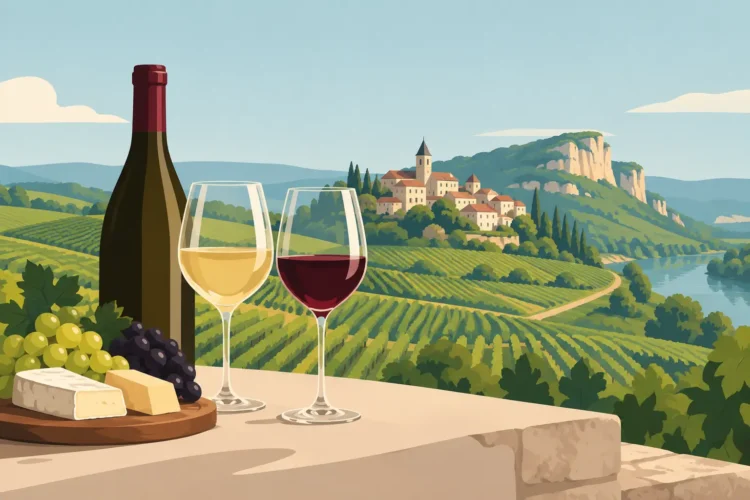
A Jura bottle can look quietly unassuming beside Burgundy or Bordeaux, then completely change the conversation at the table. This Jura wine guide is for anyone who has heard whispers of nutty Vin Jaune, feather-light reds and characterful natural wines, but would rather know what to expect before opening a bottle.
Jura is a small, mountainous wine region in eastern France, tucked between Burgundy and the Swiss border. Its scale is modest, its weather can be demanding and its wines do not follow a single house style. That is precisely the appeal. Here, Chardonnay can be bright and mineral or richly savoury; reds can be pale in colour yet full of spice; and a rare yellow wine can taste thrillingly unlike anything else in France.
What makes Jura wine different?
Jura vineyards run along a narrow band of slopes beneath the Jura mountains. Marl, limestone and clay soils matter greatly here, as does the cool continental climate. Long growing seasons preserve acidity, while growers must work around frost, rain and uneven ripening. The result is often wine with freshness, texture and real personality rather than easy, glossy fruit.
The region is also strongly producer-led. Small family estates are common, and many work organically, biodynamically or with low-intervention methods. Those terms are worth treating carefully. Organic and biodynamic farming describe how grapes are grown, while natural wine generally refers to a minimal-intervention approach in the cellar. Neither guarantees you will love every bottle, but both can be useful clues if you value provenance and thoughtful farming.
Jura has a long tradition of topping up barrels for fresh, fruit-led wines, alongside ageing some wines beneath a veil of yeast called voile. This protective layer is similar in principle to the flor used in Sherry production. It creates flavours that can be nutty, salty, curry-spiced and deeply savoury. For some drinkers, that first glass is a revelation. For others, it is an acquired taste – which is why understanding the label helps.
Jura wine guide: the grapes to know
Five grapes give Jura much of its identity. Chardonnay and Pinot Noir will be familiar, but the region’s local varieties are where the real sense of place begins.
Chardonnay
Jura Chardonnay is not simply a lighter version of white Burgundy. In a topped-up, non-oxidative style, expect lemon, orchard fruit, white flowers and stony freshness. Barrel ageing may add creaminess and gentle toast without masking that lively core.
When aged under voile, Chardonnay becomes broader and more savoury, with walnuts, preserved lemon and a saline finish. Look for words such as ouillé, meaning the barrel has been topped up, if you prefer a fresher style. A label that mentions sous voile signals the opposite: expect oxidative complexity.
Savagnin
Savagnin is Jura’s great original. Despite the similar name, it is not Sauvignon Blanc. It has naturally high acidity, firm structure and an ability to carry striking flavours of citrus peel, fennel, spice and salt.
Young Savagnin can be wonderfully tense and mineral. Under voile, it is the classic grape for Vin Jaune, becoming layered with roasted nuts, saffron, curry leaf and dried fruit. It is a wine to sip slowly, preferably with food, rather than serve as a casual large glass after work.
Poulsard and Trousseau
For red wine drinkers, Jura offers a welcome change from heavy, oaky styles. Poulsard, also called Ploussard, is famously pale – sometimes closer in appearance to a dark rosé – but has vivid redcurrant, wild strawberry, pepper and forest-floor character. Serve it lightly chilled and it is brilliant with charcuterie, roast chicken or mushroom dishes.
Trousseau is usually deeper in colour and firmer in shape. It can bring black cherry, raspberry, spice and an earthy, sometimes gamey edge. In warm vintages it can be surprisingly powerful, but it still tends to feel more nimble than a full-bodied Rhône red. Pinot Noir is also grown in Jura, often adding fragrance and silky fruit to blends or offering a cooler-climate expression on its own.
The Jura styles worth seeking out
Start by deciding whether you want freshness, savoury complexity or something genuinely unusual. A white labelled Côtes du Jura, Arbois or L’Étoile may be dry and mineral, oxidative and nutty, or somewhere between the two. Appellation tells you where the wine comes from, but the producer’s approach tells you plenty about how it will taste.
Arbois is the best-known appellation and produces every major Jura style. Côtes du Jura covers a wider sweep of vineyards and offers excellent value, particularly from careful growers. L’Étoile is best known for white wines from limestone-rich soils, while Château-Chalon is dedicated to Vin Jaune.
Vin Jaune is Jura’s landmark wine. Made principally from Savagnin, it spends at least six years and three months ageing in barrel beneath voile. Evaporation reduces the volume, so it is traditionally bottled in a distinctive 62cl clavelin, said to represent what remains from a litre after ageing. It is expensive because it takes time, skill and patience, but a bottle can develop for decades.
Do not confuse Vin Jaune with every oxidative white from Jura. A vin de voile may offer a related nutty, savoury profile at a more approachable price and with less intensity. For a gentler entry point, choose an ouillé Chardonnay or a blend of Chardonnay and Savagnin that has been topped up during ageing.
Jura also makes two sweet or fortified specialities. Vin de Paille is produced from grapes dried after harvest, concentrating sugar, acidity and flavour into a luxurious dessert wine. Macvin du Jura blends grape must with Marc du Jura spirit, creating a sweet, aromatic aperitif. Both are superb after dinner, though neither is the place to begin if you are seeking a crisp dry white.
Crémant du Jura deserves a mention too. Made by the traditional method, it can offer fine bubbles, citrus and apple fruit, and often better value than more famous French sparkling regions. It makes a smart aperitif when Champagne feels unnecessary but the occasion still calls for something celebratory.
How to choose a Jura bottle with confidence
If you are new to the region, begin with a dry, topped-up Chardonnay, or a light Poulsard served cool. These wines show Jura’s freshness and individuality without asking your palate to leap straight into walnuts and spices. From there, move towards Savagnin, voile-aged whites and Vin Jaune.
Reading a few French terms will make shopping easier. Ouillé means topped up and usually points towards a cleaner, fruit-led profile. Non ouillé or sous voile indicates ageing beneath yeast, with oxidative flavours. Vendanges tardives means late harvest, while vin de paille refers to the dried-grape method. If a label gives little away, ask for guidance rather than guess: a good independent merchant should be able to tell you whether the wine is fresh, oxidative, filtered, sulphur-free or made with minimal added sulphites.
Price varies sharply. Jura’s limited production and current popularity mean the best-known bottles are rarely bargains. Yet less celebrated appellations, younger wines and Crémant can offer a more affordable route in. Buying by producer is often wiser than chasing a fashionable style alone. At Wine Affairs, filtering by Jura, grape variety and organic or biodynamic credentials can narrow the choice without stripping away the pleasure of discovery.
Food pairings that make Jura shine
Jura wine is made for the table. Its acidity cuts through creamy food, while its savoury notes echo mushrooms, nuts and aged cheese. A fresh Chardonnay works beautifully with trout, roast chicken, leek tart or Comté. Poulsard loves pâté, cured meats and grilled sausages, while Trousseau has enough spice for duck, lentils or a mushroom and walnut pie.
For voile-aged whites and Vin Jaune, reach for Comté, of course, but do not stop there. Chicken in a cream and morel sauce is a regional classic for good reason. The wine’s nutty depth also works with cauliflower gratin, saffron risotto, roast squash and hard cheeses. A small pour is usually enough: these are flavours that unfold as the wine warms in the glass.
Serve fresh Jura whites chilled but not icy, around 10-12°C. Light reds are at their best around 13-15°C, so 20 minutes in the fridge is often useful. Oxidative whites benefit from a larger glass and a little air. Once opened, they can remain fascinating over several days when properly resealed.
The most rewarding way to approach Jura is to allow one bottle to be a first encounter rather than a test of expertise. Choose a style that suits supper, invite a few curious friends and notice what changes between the first sip and the last. That is where this small French region tends to win people over.