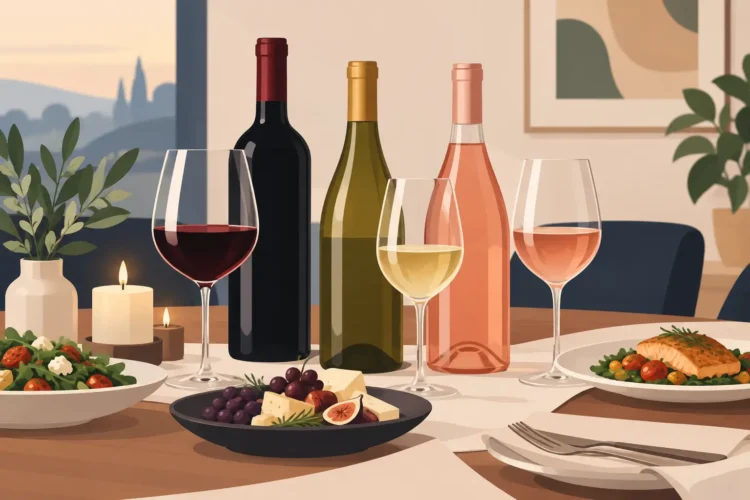
A dinner party wine does not need to be rare, expensive or explained in solemn tones from the end of the table. It needs to taste good with the food, suit more than one palate, and leave you free to enjoy your own evening. The top wines for dinner parties are usually the versatile bottles: fresh enough for a pre-dinner glass, characterful enough for the meal, and balanced enough to make guests ask for another pour.
For a French-led table, that means choosing wines with energy, moderate alcohol and honest fruit rather than reaching automatically for the biggest names or the heaviest styles. A thoughtful mix of white, red and something sparkling gives everyone a place to start.
What makes a wine work at a dinner party?
The best bottle for entertaining has a job to do. It should complement food without demanding that every course be built around it. It should also be approachable at the first sip. Very tannic reds, aggressively oaked whites and extremely dry, austere wines can be brilliant in the right setting, but they are less forgiving when guests have different tastes and the menu is still taking shape.
Acidity is your quiet ally. It keeps a white wine refreshing alongside canapés, creamy sauces and roast chicken, and it makes a red feel lively rather than tiring by the second glass. Wines from cooler French areas, or made with a light touch in the cellar, often have this useful balance.
Think about the room, too. A relaxed Friday supper with a tray of baked salmon calls for something different from a winter feast of lamb shoulder. The aim is not to find one universally perfect bottle. It is to offer a small, well-chosen range that makes your menu and your guests feel looked after.
Top wines for dinner parties: a French line-up
Start with sparkling wine
A dry Crémant is one of the cleverest party purchases in French wine. Made in the traditional method, like Champagne, it offers fine bubbles, citrus freshness and a celebratory feel without making the evening feel overly formal. Crémant de Loire often brings apple, lemon and a gentle biscuity note; Crémant d’Alsace can be particularly bright and elegant.
Serve it when guests arrive, ideally with salty nibbles, gougères, smoked fish or a simple bowl of good crisps. Sparkling wine also buys the host time: people have something festive in hand while you finish the last details in the kitchen. For a larger group, a magnum is wonderfully practical and keeps the mood generous.
Choose a textured white for the table
A versatile white is the backbone of many dinner parties. For fish, chicken, vegetable dishes, pasta with herbs, goat’s cheese or a lemony risotto, look to the Loire. Sauvignon Blanc from Touraine or Menetou-Salon has clean citrus and herbal lift, while Chenin Blanc from the Loire can offer more texture, apple fruit and a lightly waxy character that works beautifully with richer dishes.
If your food has cream, butter, mushrooms or roast squash, a carefully made Burgundy Chardonnay is a fine choice. It does not need to be a grand cru to be delicious. A Mâconnais Chardonnay, for example, can deliver ripe orchard fruit and a discreet creamy note while keeping enough freshness for the table.
The trade-off is simple: Sauvignon Blanc is sharper and more immediately refreshing; Chardonnay or Chenin generally has more weight. If you are serving one white all evening, pick the latter. If guests will begin with snacks and move on to a lighter main, Sauvignon Blanc may be the better fit.
Pour a red with freshness, not force
For mixed company, an elegant medium-bodied red is usually safer than a powerful, high-tannin bottle. Pinot Noir is a natural dinner-party grape: it has red cherry and raspberry fruit, soft tannins and enough savoury complexity for roast duck, salmon, mushroom dishes and charcuterie. Burgundy is its famous home, but excellent value Pinot can also come from the Loire, Alsace or cooler parts of Languedoc-Roussillon.
Beaujolais, made from Gamay, is another excellent crowd-pleaser. A good Fleurie, Morgon or Brouilly is juicy, floral or lightly earthy depending on the cru, and feels relaxed without being simple. Serve it a little cooler than room temperature, around 14-16°C, especially if the room is warm. This small adjustment keeps the fruit vivid and the alcohol in check.
If your menu centres on lamb, beef or a slow-cooked aubergine dish, step up to a Rhône red. A Côtes du Rhône with Grenache and Syrah can bring generous berry fruit, pepper and herbs without the stern tannins of a young Bordeaux. For a smarter, more structured choice, a Saint-Joseph or Crozes-Hermitage offers Syrah’s dark fruit and savoury spice, but it is worth decanting for an hour.
Keep a rosé in reserve
Rosé is not only for garden lunches. A dry Provençal rosé is brilliantly useful when the menu is hard to define: think Mediterranean sharing plates, grilled prawns, salads with roasted vegetables, pizza or spicy food that would flatten a delicate red. Its red-fruit fragrance and crisp finish make it easy to drink, but a good example has enough savoury texture to sit at the table rather than disappear after the aperitif.
For cooler months, seek a more structured rosé from Tavel in the Rhône or a food-focused rosé from Languedoc. These styles have more body and can handle grilled meats, paprika, tomato and garlic with confidence.
Match the wine to the way you are serving dinner
A plated three-course meal benefits from a clear progression: sparkling wine on arrival, a white with the starter and a red with the main. If dessert is planned, choose it separately. Dry table wine rarely improves a sweet pudding, and a modest glass of sweet Chenin Blanc, Muscat or late-harvest Alsace wine will make the final course sing.
For a sharing-style supper, simplify. Put one chilled white and one lightly chilled red on the table, then let the food lead. This works especially well for dishes with several flavours, such as a generous cheese board, roast vegetables, tapas-style plates or Middle Eastern-inspired food. A Loire Chenin and Beaujolais pairing covers an impressive amount of ground.
Spice needs care. Very tannic reds can feel metallic or fiery beside chilli, while high alcohol magnifies heat. An aromatic Alsace Pinot Gris, an off-dry Riesling, or a chilled, fruit-forward red is often kinder to Thai, Indian or Korean-inspired dishes. A little residual sweetness is not a flaw here – it is useful balance.
How much wine should you buy?
A 75cl bottle gives around six small tasting pours or five more generous glasses. As a practical rule, allow one bottle between two guests for the meal, then add extra for an aperitif and for anyone staying late. For eight people, six to eight bottles is usually comfortable if you are serving sparkling wine, white and red.
Variety matters more than a vast line-up. For eight guests, one or two bottles of fizz, three bottles of white and three bottles of red provides choice without filling every surface with open bottles. If you know your group leans strongly towards one style, follow their preference rather than treating red and white as a mathematical exercise.
Open reds 30 minutes before serving. Chill whites properly, then take fuller styles out of the fridge ten minutes before pouring so their aromas can open. Sparkling wine should be cold, but not icy. And do not overlook water, good bread and a few alcohol-free options: hospitality is about making every guest feel included.
Choose bottles with a story worth sharing
Wine is more enjoyable when you know a little about where it came from, but the story need not turn into a lecture. A bottle from an organic or biodynamic estate can be an easy conversation starter, particularly when the wine tastes as good as the farming is thoughtful. HVE certification is another useful signpost in France, showing a producer has met standards around biodiversity, plant protection, fertiliser management and water use.
Low-intervention and no-added-sulphite wines can be exciting choices, especially for guests keen to discover something new. They are not automatically better, and their styles can vary more from bottle to bottle. For a large occasion, choose a producer you trust and keep one classic, reliably made wine in the mix. At Wine Affairs, filtering by region, grape and farming approach makes that balancing act much easier.
The kindest dinner-party wine choice is never about showing off. Pick bottles with freshness, character and a sense of place, serve them at the right temperature, and trust the food and conversation to do the rest. Bonjour to an evening where the empty bottles are simply proof that everyone had a very good time.